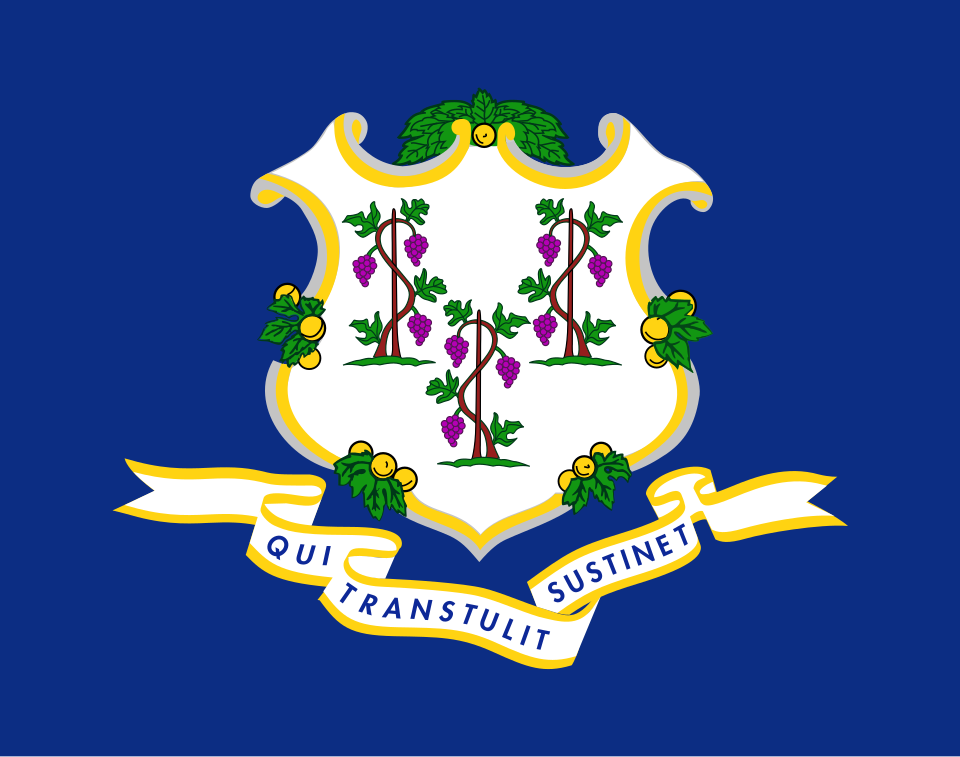
Today the flags of Connecticut flies in celebration of the state’s ratification of the constitution on July 9, 1788. The flag of Minnesota flies in memory of Renee Good.
Connecticut
The flag of Connecticut flies in commemoration of the state’s ratification of the United States Constitution on January 9, 1788, making it the sixth state to do so.

Connecticut General Statutes § 3-107 defines the flag as follows, “The following-described flag is the official flag of the state. The dimensions of the flag shall be five feet and six inches in length, four feet and four inches in width. The flag shall be azure blue, charged with an argent white shield of rococo design, having in the center three grape vines, supported and bearing fruit in natural colors. The bordure to the shield shall be in two colors, gold on the interior and silver on the exterior, adorned with natural-colored clusters of white oak leaves (Quercus alba) bearing acorns. Below the shield shall be a white streamer, cleft at each end, bordered by a band of gold within fine brown lines, and upon the streamer in dark blue block letters shall be the motto “QUI TRANSTULIT SUSTINET”; the whole design being the arms of the state.”
Minnesota
The flag of the state of Minnesota flies in memory of Renee Good, who was shot and killed by an agent of the United States Immigration and Customs Enforcement on Wednesday, January 7th in Minneapolis, Minnesota.

There are at least two conflicting versions of what happened being told at the moment, the first is that Ms. Good had just dropped her children off at school and was caught up in an unfortunate situation and unjustly killed by the agent. The available video evidence seems to back this up. Ms. Good’s wife acknowledges that both she and her wife have organized “to monitor and protest immigration and enforcement activity in their neightborhoods.
The federal government’s version of the story is different. A spokesperson for the Department of Homeland Security stated that Ms. Good, “…was stalking agents all day long, impeding our law enforcement.” The Vice President of the United States blamed the victim for her own death and the Secretary of Homeland Security said that Ms. Good’s actions were, “an act of domestic terrorism.”
These are certainly differing accounts of both the person and what happened. The differences in these accounts brings up a question: When can we believe our government? Erika Kranz begins her July 2025 publication entitled, “When Government Gets It Right: A Framework for Assessing When Agencies Deserve a Presumption of Regularity” by asking the following question, “How do courts assess whether they should presume regularity when government decision making seems highly irregular?” She goes on to explain, “Courts ordinarily assume that they can trust an agency’s assertions about the process it used to come to a decision, the scope of the record on which it relied, and its reasons for reaching a decision. This presumption of regularity — the assumption that the government follows the rules and tells the truth — has attracted scrutiny in recent years, as courts question the federal government’s rationales, particularly in cases involving new or changed policies concerning highly political issues.”
Can we as citizens make that presumption today? Can the courts? Can we believe that the federal government as well as its elected officials, agents, and employees are credible in their recounting of events and actions? This question was litigated during the first Trump Administration and is being discussed and litigated today based upon numerous actions of the federal government.
What is the difference between a domestic terrorist and a person who has organized their friends and neighbors to monitor and protest actions of the government? What is the difference between a former military officer and current United States Senator reminding members of our armed forces that they don’t have to follow illegal orders and “making seditious statements” as the Secretary of Defense has accused him of? What does it mean when the federal government seems to conduct itself in bad faith in regard to a court’s order?
I am not an expert, but watching the videos of Ms. Good’s interactions with the Immigration and Customs Enforcement agent, she did not appear to be a deadly threat to the agent. Certainly, Ms. Good’s vehicle moved towards him, from all accounts, he was able to step out of the way and was not injured. The Department of Homeland Security “Policy on the Use of Force” General Principles section begins with the text, “All DHS personnel have been entrusted with a critical mission: safeguarding the American people, our homeland, and our values. In keeping with this mission, respect for human life and the communities we serve shall continue to guide DHS LEOs in the performance of their duties.”
I give great deference to police officers and federal agents, because I have never worked in a job that has the possibility of putting my life at risk every day. However, as agents of the state, I place a high responsibility on them to do everything possible before using any kind of force, especially deadly force.
I wasn’t there in Minneapolis on Wednesday, I have only seen short snippets of video of the interaction between Ms. Good and the Immigration and Customs Enforcement Agent, but from what I have seen, I don’t believe the federal government deserves the presumption of regularity in this case. It saddens me that I don’t believe the statements of the Vice President, Secretary of Homeland Security, and the spokesperson for the Department of Homeland Security about the tragedy that occurred here.
I want to give the presumption of regularity, I want to be able to believe the federal government. Unfortunately, I can’t any more. The actions of the President and his administration, along with the actions of majority party in congress in not holding the administration to account make it impossible for me to do so.
Back to vexillology for a moment. Minnesota Statutes §1.141 reads as follows: “The design of the state flag as certified in the report of the State Emblems Redesign Commission, as established by Laws 2023, chapter 62, article 2, section 118, is adopted as the official state flag.’ The report describes the flag as such, “On its left side, the flag contains a dark blue background with a white, 8 point star. One of the points of the star points north. The dark background is in the shape of the outline of the State of Minnesota. The remainder of the flag is a solid, bright blue.”
 Cruesbreck Flags