Today, the flag of South Africa flies in celebration of Freedom Day. This public holiday celebrates the nation’s first post-apartheid elections held in 1994 as well as the day the nation’s interim constitution came into effect.
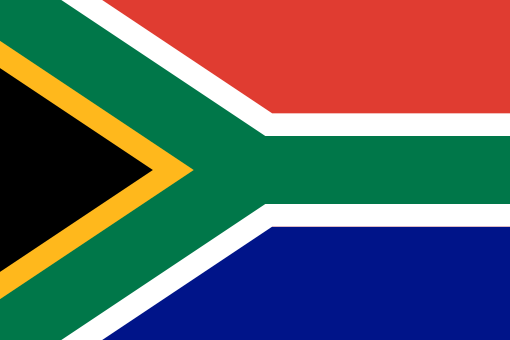
South Africa’s flag was adopted on the same date as the election and interim constitution came into effect, April 27, 1994. Schedule 1 of the Constitution of South Africa, 1996 describes the flag thusly:
- The national flag is rectangular; it is one and a half times longer than it is wide.
- It is black, gold, green, white, chilli red and blue.
- It has a green Y-shaped band that is one fifth as wide as the flag. The centre lines of the band start in the top and bottom corners next to the flag post, converge in the centre of the flag, and continue horizontally to the middle of the free edge.
- The green band is edged, above and below in white, and towards the flag post end, in gold. Each edging is one fifteenth as wide as the flag.
- The triangle next to the flag post is black.
- The upper horizontal band is chilli red and the lower horizontal band is blue. These bands are each one third as wide as the flag.
The South African Vexillological Association put together a South African Flag Guide.
Also flying is the flag of Namibia, which borders South Africa to the northeast. This flag was a gift from my sister.
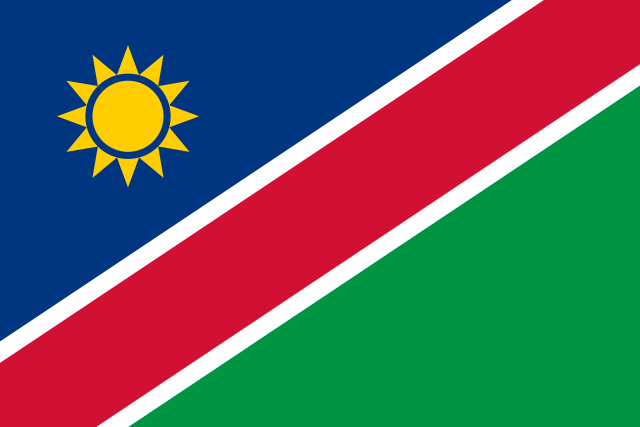
Namibia gained its independence from South Africa in 1990. It is described in Article 2, Section 1 as well as Schedule 6 of the Constitution of Namibia. Schedule 6 described the flag as follows, “The National Flag of Namibia shall be rectangular in the proportion of three in the length to two in the width, tierced per bend reversed, blue, white and green; the white bend reversed, which shall be one third of the width of the flag, is charged with another of red, one quarter of the width of the flag. In the upper hoist there shall be a gold sun with twelve straight rays, the diameter of which shall be one third of the width of the flag, with its vertical axis one fifth of the distance from the hoist, positioned equidistant from the top edge and from the reversed bend. The rays, which shall each be two fifths of the radius of the sun, issue from the outer edge of a blue ring, which shall be one tenth of the radius of the sun.”
The origin of the flag is disputed, with several people claiming the design.

